





City of Yokohama - Yokohama Smart City Project
Storage battery for supply-and-demand regulation system
In April 2010, Yokohama City launched the Yokohama Smart City Project (YSCP) in collaboration with Toshiba and other private enterprises. Yokohama is one of the areas selected by METI as "Next-Generation Energy and Social Systems Demonstration Areas."
CEMS2 began a battery SCADA demonstration at the Battery SCADA Demonstration Center in Kohoku, Yokohama.
Battery SCADA virtually manages multiple battery energy storage systems (BESS) as a single large battery. Based on the SCADA commands, CEMS2 aims to promote stable electricity grids through peak-load shifting and load frequency control (LFC).
BESS specifications: Maximum output: 300 kW, Capacity: 100 kWh
- Safety
- Long Life
- Low-temp Operation
- Wide SOC Range
- High Input / Output



Engie S.A.
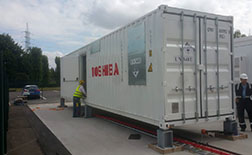
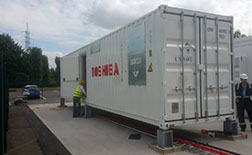
SCiB™ has been adopted for battery energy storage system at Drogenbos Thermal Power Plant in Brussels
SCiB ™ has been adopted as the high-power type battery system in the Energy Storage Park project (large scale battery system demonstration project) being carried out at the Drogenbos thermal power plant, and frequency regulation control operation has been in operation since September 2018.
The hybrid operation of high-capacity and high-power battery systems makes it possible to reduce operating costs and life cycle costs in comparison to high-capacity batteries alone.
- Long Life
- High Input / Output
Miyakojima City - Kurima Island 100% Renewable Energy Self‑Sufficiency Demonstration Project
Battery energy storage system (BESS) for a renewable energy self-sufficiency demonstration project on Kurima-jima Island, Miyako
In January 2014, Miyako City and Okinawa Electric Power Company, Inc. (OPEC) began a demonstration project on Kurima-jima of the Miyako Islands, Okinawa to achieve 100% self-sufficiency in electricity.
Working towards self-sufficiency in electricity, the Kurima-jima Island aims to generate all its electricity from solar photovoltaic power and store it in stationary battery energy storage systems so as to minimize or eliminate electricity flow coming from Miyako-jima (main island) through a high-voltage transmission line.
BESS specifications: Two units, each with the maximum output of 100 kW and a capacity of 176 kWh
Solar photovoltaic generation by consumers: 380 kW
- Safety
- Long Life
- Low-temp Operation
- Wide SOC Range

Miyakojima City - Field Demonstration for Utilization of Small Electric Mobility Vehicles
Field demonstration for utilization of small electric mobility vehicles
This project visualizes energy supply and demand in real time using Toshiba's Feminity home IT system, provides ultra-small electric vehicles (EVs), and deploys three charging stations in the city of Miyakojima to make it possible for EVs to run on renewable energy. The charging stations consist of solar photovoltaic panels and battery energy storage systems.
(Joint collaboration with the city of Miyakojima, Honda Motor Co., Ltd. and Honda R&D Co., Ltd.)
- Safety
- Long Life
- Wide SOC Range

Terna S.p.A.
For Terna Storage S.p.A., Italy. BESS for Frequency Regulation
In 2013, Toshiba have concluded a contract with Terna Storage S.p.A., a wholly subsidiary of Italian Transmission System Operator Terna S.p.A., for Battery Energy Storage System for frequency regulation purpose. All the installation work has been done and the system had already been handed over to Terna Storage in July 2015 for the system in Sardinia, and in September 2015 for the system in Sicily.
The grid stabilization is becoming one of the crucial issues for Italian transmission network as the penetration of renewable energy rise. Our system is highly valued as a solution that could realize stable grid by controlling frequency and grid fluctuation.
BESS Specification: Rated Output 1MW, Capacity 1MWh (for both 2 sites)
- Safety
- Long Life
- Wide SOC Range
- High Input / Output

Tohoku Electric Power Network Co., Inc.
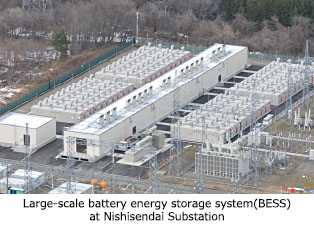
Battery energy storage system for reducing grid frequency changes at Nishisendai Substation
The BESS is installed at Tohoku Electric Power Network’s Nishisendai Substation to reduce grid frequency changes caused by weather-dependent power fluctuations that result from the increasing use of renewable energy resources such as wind and photovoltaic power generation systems. This demonstration project was launched as a new approach to verifying the BESS's ability to regulate frequency changes.
BESS specifications: Maximum output: 40 MW, Capacity: 20 MWh
- Safety
- Long Life
- Wide SOC Range
Tohoku Electric Power Network Co., Inc.
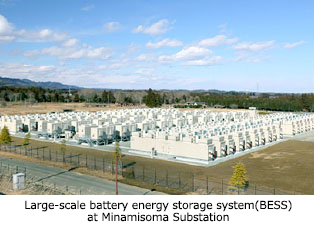
Battery energy storage system (BESS) at Minamisoma Substation for improving the supply-demand balance
The BESS is installed at Tohoku Electric Power Network’s Minamisoma Substation to improve the supply and demand balance of renewable energy. Because the output of renewable energy power generation fluctuates depending on weather conditions, this system stores surplus electricity when the supply of renewable energy power generation, exceeds demand and releases the stored electricity at times of high demand
BESS specifications: Maximum output: 40 MW, Capacity: 40 MWh (world's largest*1)
*1 As of May 29, 2015 (as surveyed by Toshiba)
- Safety
- Long Life
- Wide SOC Range
Willey Battery Utility, LLC
Large-scale battery energy storage system for frequency regulation
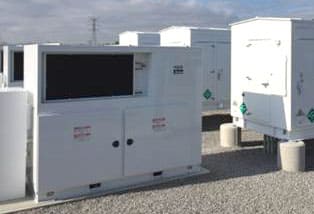
Sumitomo Corporation and Willey Battery Utility, LLC, a subsidiary of Sumitomo Corporation of Americas, deployed a large-scale battery energy storage system (BESS) for power frequency regulation in the suburbs of Cincinnati, Hamilton, Ohio, U.S. The BESS will be utilized to provide an ancillary services through a frequency regulation market operated by PJM, the largest regional transmission organization (RTO) in the U.S. The BESS is utilized as an effective tool for further promoting renewable energy while ensuring the stability of electrical grids.
BESS specifications: Maximum output: 6 MW, Capacity: 2 MWh
- Safety
- Long Life
- Wide SOC Range
- High Input / Output
Vehicles

Commercial Vehicles
Industrial Equipment
Electrical Power & Energy Storage
-
Electrical Power & Energy Storage
Railways
Marine Vessels & Container Cranes
White Papers Present Industry-Specific Applications and Best Practices


