

Addressing the “2025 Digital Cliff” with People and AI - Toshiba Digital Solutions’ DX Strategy (Part 2)
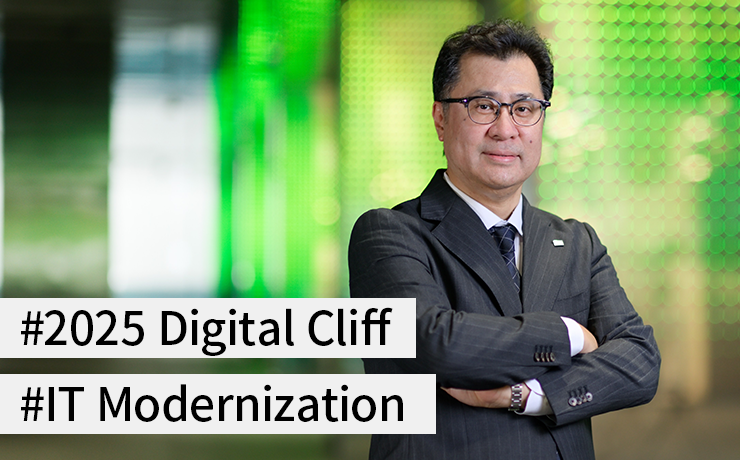
In 2018, the Ministry of Economy, Trade and Industry (METI) warned of the “2025 Digital Cliff.” The report indicated that aging systems could hinder business transformation and growth, worsening IT talent shortages and potentially leading to significant economic losses. These concerns are now becoming a reality. Toshiba Digital Solutions views this crisis as an opportunity for transformation and has been advancing strategic digital transformation (DX) centered on IT modernization. We spoke with Technology Executive KADO Shingo, who has led stepwise modernization, development innovation using generative AI, and engineer training, about specific reforms in development sites, talent development initiatives, and future outlook. In this second part, he discusses the type of talent Toshiba seeks, its initiatives for talent development, and his outlook for the future.
(Read Part 1 here)

Developing Talent to Drive DX―Focusing on PM, PdM, and Global Talent Development
―Technology alone is not enough—people who can fully leverage it are equally important. What kinds of talent is Toshiba developing to address social challenges and drive business transformation for customers?
No matter how advanced technology may be, its true value cannot be realized without people who can make full use of it. That is why we are strategically investing in the development of DX talent, including AI specialists. The essence of DX lies not only in adopting digital technologies, but in creating new value and transforming operations based on their data. To continuously support customer DX and maximize the value of data after system deployment, we believe it is essential to develop and secure talent capable of driving DX. To this end, the Toshiba Group has defined 12 key roles required to realize DX. Among these, I am currently focusing on the development of project managers (PMs). Successfully delivering DX and large‑scale IT modernization requires not only strong technical capabilities, but also professionals with strong interpersonal skills to coordinate stakeholders, as well as leadership and management capabilities to oversee projects, assess risks, and lead teams effectively.
There is an industry‑wide shortage of experienced PMs. To address this, we have established a structured development program to expand the pool of PMs capable of leading large‑scale projects. This program combines classroom‑based learning, project-based on-the-job training, mentoring by experienced PMs, and follow‑up programs over several years to support continuous growth. Many participants are already contributing in real projects. We’ve also created an “Advanced Expert Program” for highly skilled professionals who can lead both internally and externally in key domains. This program enables PMs to further refine their expertise, advance their careers, and be appropriately recognized as professionals within the organization. These initiatives enhance PM motivation and contribute to the steady development of leaders capable of managing large‑scale projects.
We are also focusing on developing product managers (PdMs), who are responsible for overseeing the planning, development, and continuous improvement of products and services, as well as maximizing business value based on customer experience. PdMs define value, while PMs lead projects to ensure that this value is effectively delivered to customers. By strengthening collaboration between these roles, we aim to maximize customer experience value. Developing PdMs is a key part of this effort.
―In Japan, the declining birth rate and aging population are leading to severe labor shortages. In order to promote DX, how do you view the importance of developing and securing globally competitive engineers going forward?
As you pointed out, Japan’s shrinking and aging workforce is intensifying the shortage of IT talent amid rapidly growing demand. To address this challenge, measures such as offshore development and the hiring of international engineers are effective. At the same time, it is essential to develop and secure Japanese engineers who can perform effectively in global environments. Engineers with global‑level skills and strong communication capabilities play a critical role in maintaining corporate competitiveness and sustaining growth in the IT industry. To develop such talent, we are strengthening collaboration with overseas sites and increasing opportunities for early‑career engineers to participate in offshore development projects. By working with overseas partners, they gain practical experience in application development and project management, enabling their growth. We provide early support to help them become engineers who can communicate effectively across different cultural backgrounds, values, and practices, while also building strong relationships with overseas partners and engineers across the Toshiba Group (Fig. 3).

Looking at our training framework, in the past we primarily offered training organized by technical domains. Today, however, there is a growing need for DX talent who can deeply understand their business, conceptualize effective ways to leverage data and digital technologies in response to change, articulate a clear vision, engage stakeholders, and lead transformation. Of course, no single individual can fulfill all these roles. Therefore, we have developed training programs and career development plans tailored to different roles and skill sets. By linking the growth of DX talent with clear career paths, individuals can better understand their future goals and the actions needed to achieve them. Our goal is to build a diverse organization where individuals can maximize their strengths and collaborate effectively as a team.
Future Outlook: Opening New Horizons Through AI‑Driven Development
―Finally, could you share your outlook for the future and the direction you aim to pursue?
Looking ahead, there will be increasing demand for systems that continuously create value from corporate data. In response to this trend, we will further shift toward a data services‑centric business that supports and advances our customers’ DX. The approach no longer ends with delivering a system to the customer. We aim to shift toward an “Everything as a Service” (XaaS) business model, in which data generated through system operation is continuously leveraged to create value for our customers. To support this shift, we are further enhancing software development productivity.
As a key initiative, we are advancing “AI‑Driven Development.” In this approach, AI agents take on central roles in tasks such as design, review, and coding, while humans focus on validation, freeing them to engage in more creative and strategic work. To realize this collaborative environment between AI agents and humans, it is essential to establish development processes and templates designed for AI‑driven workflows. This includes, for example, redesigning workflows and further enhancing standardized design document formats. Through these efforts, we aim to achieve both greater development efficiency and higher quality.
We believe our mission is to solve social challenges through the power of digital technologies and to realize a safe and secure society. As a company engaged in developing critical systems that support society, including social infrastructure and manufacturing, ensuring high quality and reliability is our top priority. At the same time, we must respond to the ever‑changing social challenges and environments by continuously creating new value. To achieve this, we will continue to enhance advanced technologies such as AI while accelerating open innovation and strengthening collaboration with customers and partners.
People, AI, and Toshiba’s expertise.
By bringing these three elements together, we aim to overcome the “2025 Digital Cliff,” open new frontiers, and contribute to both business and society.
(Read "Addressing the “2025 Digital Cliff” with People and AI - Toshiba Digital Solutions’ DX Strategy (Part 1)" from here)

KADO Shingo
Toshiba Digital Solutions Corporation
Technical Exective
KADO Shingo has led projects across multiple domains, including system development (PM), software engineering technologies, solution development, and the promotion of productivity initiatives. As a Technology Executive, he currently drives AI‑Driven Development, with a focus on quality and reliability, while also strengthening project manager training and global talent development. He is engaged in enhancing the value of social infrastructure through a shift toward data services and the advancement of IT modernization.
- The corporate names, organization names, job titles and other names and titles appearing in this article are those as of February 2026.
- All other company names or product names mentioned in this article may be trademarks or registered trademarks of their respective companies.