


Toshiba to Supply Energy Management System and Power-type Battery Energy Storage System to Power Supply Improvement Project in Mongolia
- Maximizing effective use of renewable energy to contribute to stable power supply -
October 23, 2026
Kawasaki, Japan – Toshiba Corporation has secured an order under Mongolia’s Power Supply Improvement Project for an energy management system (EMS) and a power-type battery energy storage system (BESS). Manufacturing of the systems has begun.
The EMS and BESS will be installed at Darkhan Substation, operated by National Power Transmission Grid State Own Stock Company (NPTG), in Darkhan, the country’s third-largest city in north-central Mongolia. The project is financed through a grant aid program of the Government of Japan, and the operation of the EMS and BESS is scheduled to start in December 2027 (Fig. 1).
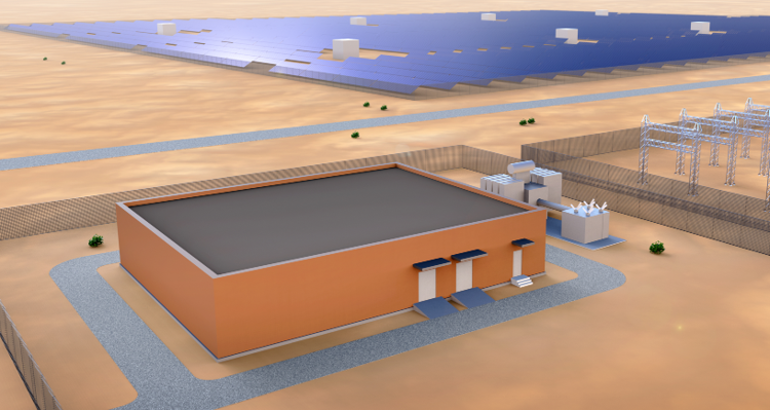
As electricity demand rises in line with the country’s economic growth, Mongolia faces operational issues in its energy sector, including transmission losses during delivery from power plants to distant demand centers, an aging fleet of coal-fired thermal plants, and growing electricity imports from neighboring countries. The country has set itself the target of raising the share of renewable energy in its installed power generation capacity to 30% by 2030, as part of its work toward a decarbonized society. Achieving this goal requires more effective use of electricity, including power generated from renewable sources.
Darkhan Substation supplies electricity to Mongolia’s three most important economic centers: Darkhan, Erdenet, and Ulaanbaatar, the capital. As part of the project, the EMS and BESS that Toshiba provides will be installed to build a microgrid that incorporates power generated from an existing adjacent photovoltaic power plant (PV). The goal of the project is to realize a model that maximizes the use of electricity generated by the PV facility and that provides urban areas with a stable supply of electricity containing a higher share of renewable energy.
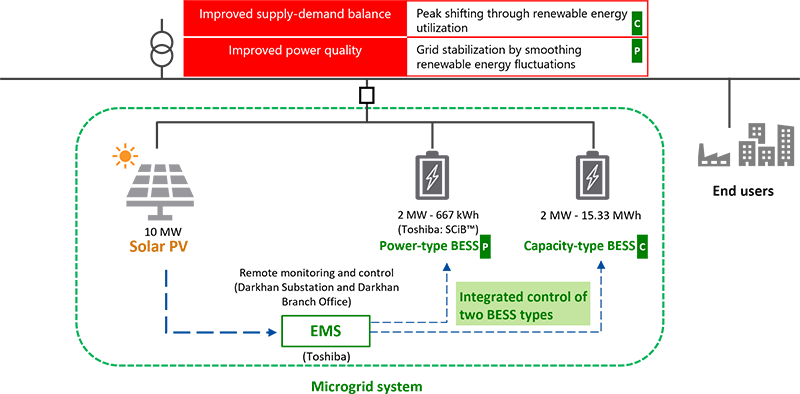
In this microgrid system, Toshiba’s EMS will integrate and manage electricity sourced from the PV facility and two BESS, whereas previously electricity was supplied solely by thermal power plants. The system will optimize the balance between electricity supply and demand while increasing the share of renewable energy in the supply mix.
Typically, microgrid systems deploy a single type of BESS to handle both output fluctuations and electricity storage, which prevents making full use of the BESS for energy storage. The project in Darkhan combines two types of BESS, one optimized for power output and the other for energy capacity, and realizes a versatile hybrid system that performs both functions simultaneously.
The power-type BESS will utilize Toshiba’s SCiB™ rechargeable lithium-ion batteries, which deliver a high level of safety, long life and high input and output performance. The SCiB™ will handle the frequent charging and discharging over short periods that is necessary to suppress fluctuations in PV output. This will reduce the load on the capacity-type BESS and secure both stabilized PV output and effective use of stored electricity.
Once installed, the EMS will forecast PV generation and electricity demand and provide integrated control of the hybrid system, realizing optimized operation and effective use of the characteristics of the deployed BESS. The system’s overall operating status can also be monitored and controlled remotely from PCs installed at NPTG’s head office and at the Darkhan branch (Fig. 2).
Toshiba will continue to utilize the technologies and expertise in EMS and BESS that it has developed in its international business. It will contribute to the advance toward carbon neutrality with energy solutions that support a stable power supply and the wider, effective use of renewable energy.
Information in the News Release, including product prices and specifications, content of services and contact information, is current on the date of the News Release , but is subject to change without prior notice.


