


Japan faces a major challenge: a labor shortage caused by a shrinking working-age population. As the aging of skilled technicians accelerates, manufacturing sites must move away from traditional practices that rely heavily on individual expertise. To address these challenges, the manufacturing industry is under increasing pressure to evolve. In recent years, initiatives to build smart factories and accelerate digital transformation have gained momentum globally. Against this backdrop, to remain competitive, companies need to implement Manufacturing Execution Systems (MES) to digitize operations, improve productivity, reduce costs, and strengthen quality management. MES Package NEO is Toshiba Group’s next-generation MES solution, designed to support both mass production and make-to-order manufacturing. It leverages decades of experience in producing a diverse range of products to deliver advanced capabilities for modern manufacturing environments.
MES unifies manufacturing execution across multi-product manufacturing sites
Simply put, an MES is a system for real-time control and management of production processes in manufacturing sites. It creates work schedules based on production plans, issues instructions to operators and staff, monitors progress and quality, tracks equipment conditions, and offers centralized control of the entire production process. Collected data is utilized to visualize operations and improve efficiency on the shop floor.
Since 2003, Toshiba Digital Solutions has been delivering MES solutions for semiconductor manufacturing, and in 2015, it introduced MES Package as part of its solution lineup for the broader manufacturing industry. MES Package has been widely adopted in semiconductor and electronics plants.
Originally, MES Package was an enhanced MES tailored for the semiconductor sector. Building on this foundation and Toshiba Group’s deep manufacturing expertise—honed through decades of producing diverse products in fields such as energy and social infrastructure—we developed MES Package NEO. This next-generation MES features a completely redesigned data model that supports both mass production and make-to-order manufacturing, providing a flexible solution for manufacturers across various industries.
MES Package NEO was developed in response to the growing complexity of manufacturing and business environments, driven by globalization, rapidly changing customer needs, technological advances, and environmental challenges. Companies need manufacturing sites that can respond quickly to these changes, along with the ability to make fast, accurate management decisions.
In addition, companies that have built their own MES from scratch often face challenges such as lack of flexibility, limited system knowledge among aging personnel, and difficulties in maintaining or upgrading aging systems. Similarly, companies running multiple MES platforms for different products or processes face challenges such as differences in the level of granularity* and types of data managed by each MES, as well as the need for separate maintenance for each system.
* For example, if one site tracks production by broad process stages while another tracks it at the level of individual operator tasks, their data cannot be compared, creating significant challenges.
Typically, MES systems have been specialized for specific product types. To address these challenges, we set out to develop an MES that works across all product types and production methods, enabling unified production execution management at the plant and even company-wide level. This MES standardizes manufacturing processes, allowing sites to adapt flexibly to change and supporting rapid, data-driven business decisions.
The key: a versatile data structure powered by Toshiba expertise
MES Package NEO can handle both mass production and make-to-order manufacturing. This flexibility is made possible by a completely overhauled data model that introduces a versatile data structure. In mass production, master data is prepared in advance, including essential manufacturing information: the Bill of Materials (BOM) for component composition and the Bill of Process (BOP) for process order and details. Manufacturing information in the master data, along with work instructions based on mass production plans, is used for daily results entry. Leveraging this MES data streamlines shop floor operations and helps minimize human error.
In make-to-order manufacturing, managing different manufacturing information for each project is key to accommodating customization and configuration changes. Therefore, alongside standard manufacturing information, the data structure is designed to also handle project-specific data. With standard manufacturing information pre-registered in the master data, project-specific manufacturing information can be easily defined. Through extensive discussions and leveraging decades of Toshiba Group manufacturing experience, we developed a standardized, common data structure supporting both mass production and make-to-order manufacturing.
By accommodating both approaches, MES Package NEO enables assemble-to-order (ATO) production. In recent years, it has become increasingly common for manufacturing sites to produce standard components in advance and assemble the final product only after receiving a customer order. Even if a product is redesigned, components common to both versions can still be used, so that pre-produced components are not wasted. In manufacturing sites like these, MES Package NEO integrates two previously separate MES systems—one for component mass production and another for final product assembly—into a single solution. MES Package NEO enables centralized management of master data that integrates both component and finished product information, thereby facilitating product traceability.
Flexible function selection for gradual expansion
With its versatile data structure, MES Package NEO supports mass production and make-to-order manufacturing, complies with international standards (ISA-95, ISO 22400), and provides many of the core MES functions as standard (Fig. 1).
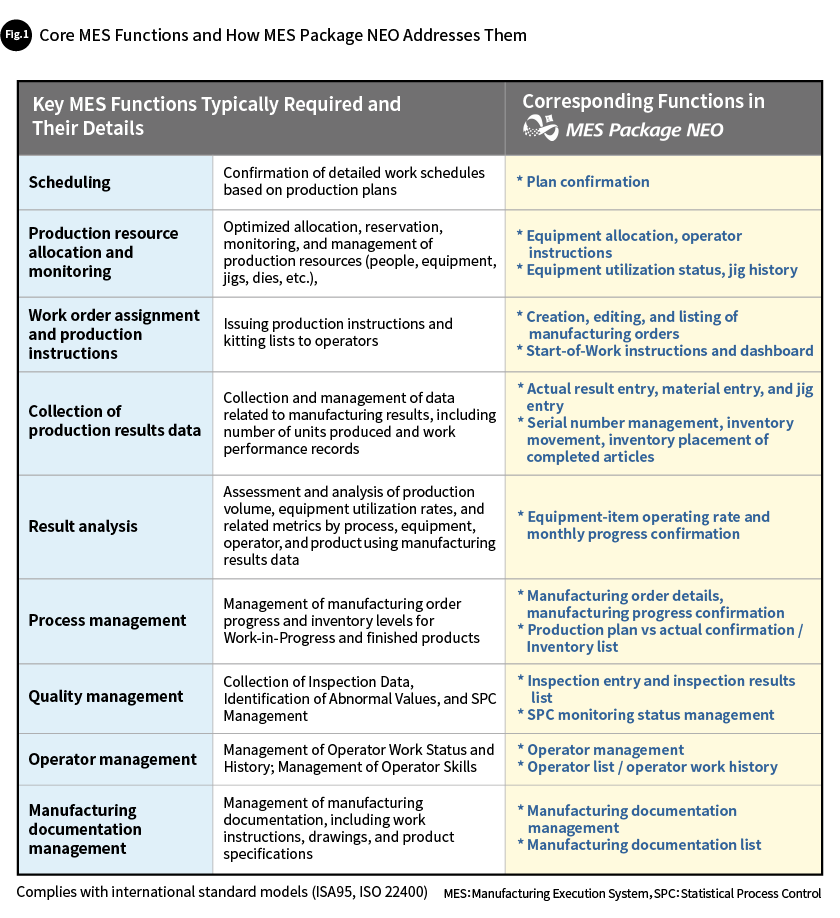
This rich set of functions addresses a wide range of challenges faced on the manufacturing sites. For example, its scheduling function helps reduce time-consuming setup operations. This is because production plans for items and orders can be viewed visually and in real time on the shop floor using Gantt charts. The data collection function captures granular details for every operation phase—initiation, start, suspension, resumption, end, and final completion. This allows real-time tracking of production line status and eliminates inter-process bottlenecks to enhance overall productivity.
Because functional requirements vary by customer, we designed the system to allow flexible selection. For example, customers may begin by checking production results and process status using three functions—“Manufacturing Plan Confirmation,” “Manufacturing Order Creation/Editing,” and “Process Progress Management (Planned vs Actual)”—based on their specific requirements. Once deployed, MES functions can be extended step by step. For instance, additional capabilities may include collecting equipment utilization data to improve operation management or integrating with planning systems such as Enterprise Resource Planning (ERP) to optimize production planning and inventory levels. This flexible approach enables a small start and gradual enhancement at the customer’s own pace, as well as assigning different functions to individual sites, such as factories (Fig. 2).

Flexible screen layout and the importance of requirement definition
We leveraged our accumulated expertise in designing the standard screens of the MES. The rich and varied set of standard screens embodies the Toshiba Group's best practices. We also enabled users to customize screen layouts for greater usability and to view the data most relevant to their operations. For example, users can customize the screen arrangement by repositioning tables and graphs, renaming items, hiding those not needed, and changing their display order. In addition, they can also create charts based on their own key performance indicators (KPIs).
This high level of flexibility in the user interface (UI) is enabled by TALON, a low-code development tool from HOIPOI Co., Ltd., which has been adopted by more than 400 companies. TALON offers ease of use, allowing screens to be designed directly in the browser and enabling real-time verification of changes. It also provides a set of preconfigured elements, including lists, forms, charts, Gantt charts, and workflows. This significantly reduces rework compared to developing screens from scratch, with actual cases showing a reduction in development effort of about 25%.
We have introduced some of the key features of MES Package NEO. It provides extensive design flexibility through its diverse set of functions and configurable screen layouts. To fully utilize this design flexibility and achieve optimal outcomes, requirements definition is a critical step during MES implementation. Drawing on our expertise, we have standardized the requirements definition process and continuously refined it through practical application within the Toshiba Group.
The process begins by mapping the customer's existing workflows and establishing common rules and procedures, followed by defining standard processes from this foundation. To streamline this process, we provide operation analysis templates, such as interview sheets for assessing overall process conditions and process flowcharts.
After standard processes are defined, the next step is to conduct a Conference Room Pilot (CRP)* and perform gap analysis. In many cases, implementing an MES involves unique customization for each customer. Therefore, CRP is conducted to identify gaps and finalize the required functions and customization specifications. During this process, the previously mentioned TALON plays a key role. TALON enables quick refinement and validation of screen designs and process workflows by leveraging the gaps identified through gap analysis as a basis, ensuring requirements definition is both fast and efficient.
* CRP (Conference Room Pilot): A method used to test system functionality, performance, and usability. The term originates from the concept of conducting pilot tests in a conference room and refers to pre-implementation verification during the design phase.
Smart factory enablement via manufacturing data integration platform
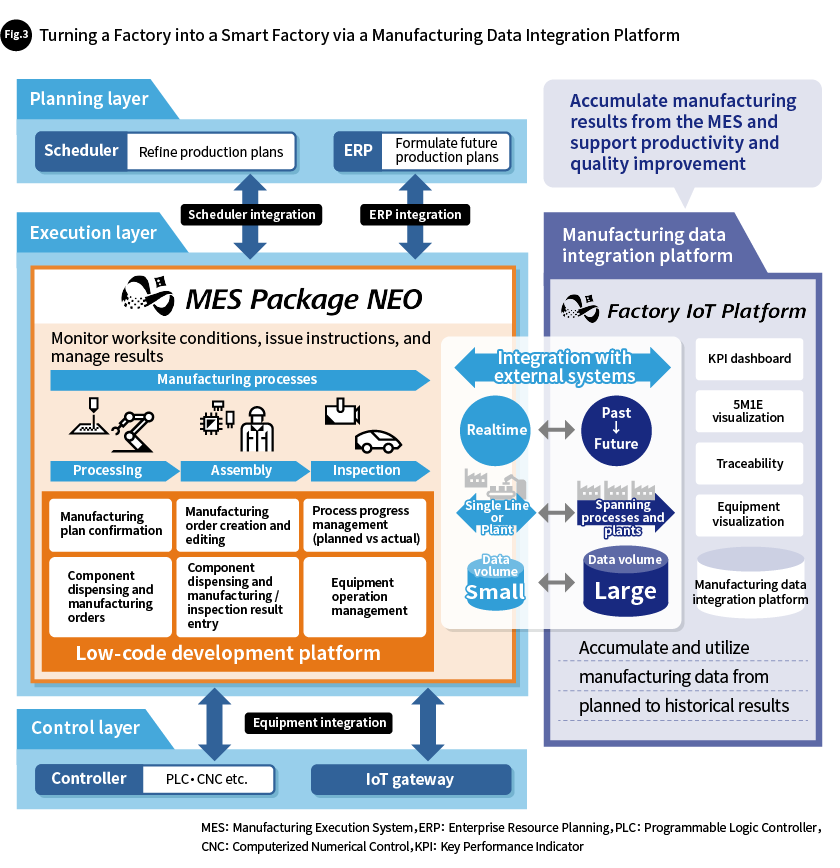
MES Package NEO offers a comprehensive set of features, beginning with requirements definition support. It delivers robust MES functionality, flexible feature selection for phased expansion, a wide range of customizable screens, and a data structure independent of product types and production models—supporting both mass production and make-to-order manufacturing. These capabilities make it highly adaptable to diverse manufacturing environments. Integration with ERP and scheduling systems enables issuing production orders based on their plans and collecting and managing production results. By digitizing the real-time status of the manufacturing site using collected data, it becomes possible to maintain production volume and respond to increased demand, thereby improving operational efficiency and productivity.
In addition, Toshiba offers the Factory IoT Platform, a manufacturing data integration solution for unified management of manufacturing data. By aggregating MES-collected data into this integration platform, manufacturers can leverage historical performance data and data from different processes and plants to drive improvements on the manufacturing site. This also supports smart factory enablement, a key enabler of digital transformation (Fig. 3).
We are exploring frameworks for efficient system operation and advanced data analytics, with a view to leveraging AI. As a manufacturing company, we implement this system on our own manufacturing sites, gaining hands-on experience and applying the insights and feedback we gather to improve our solutions. MES Package NEO from Toshiba Digital Solutions will keep evolving to drive digital transformation on manufacturing sites.
- The corporate names, organization names, job titles and other names and titles appearing in this article are those as of August 2025.
- All other company names or product names mentioned in this article may be trademarks or registered trademarks of their respective companies.